
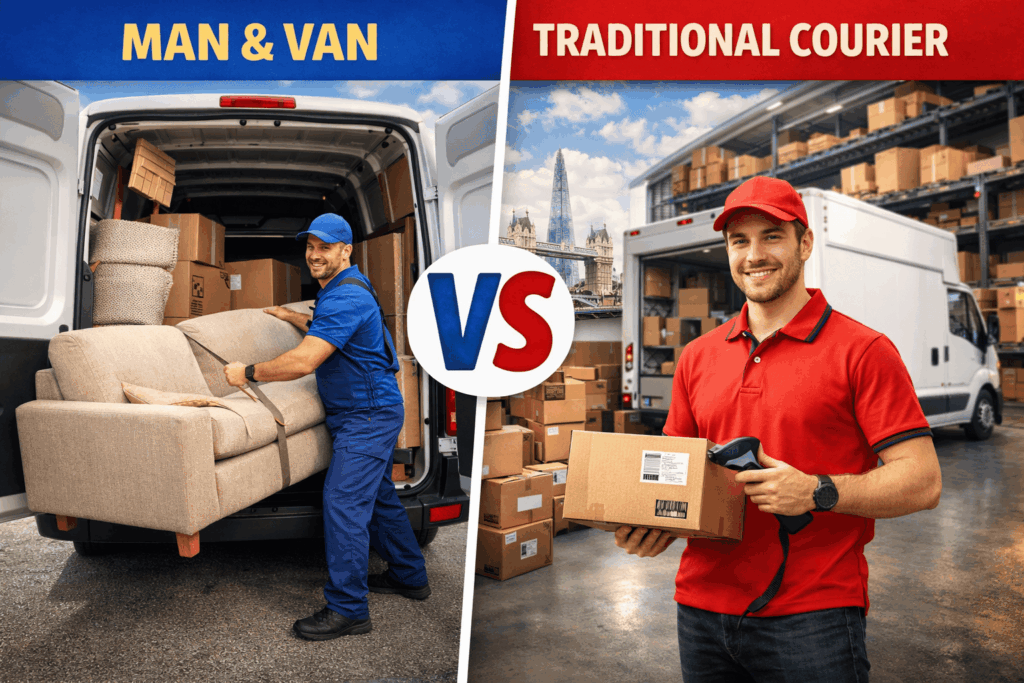
Choosing a delivery service sounds simple – until you’re staring at a bulky item, a tight deadline, or a customer who needs a specific time slot. In the UK (especially in London), two popular options often come up: man and van services and traditional couriers. They solve different problems, and picking the right one can save you money, time, and stress.
This guide breaks down the key differences so you can quickly decide what fits your delivery – whether you’re a small business shipping goods, a homeowner moving a few items, or someone who just needs a reliable local courier.
What “Man and Van” Really Means
A man and van service typically includes a driver (often with optional help for loading/unloading) and a vehicle suited for larger or multiple items. Instead of sending a parcel into a sorting network, your items usually travel directly from pickup to drop-off – often with fewer handovers.
Best for:
-
Furniture, flat-pack items, appliances
-
Multiple boxes or bags in one trip
-
Time-slot deliveries (when you need someone to arrive at a set time)
-
Help with lifting, stairs, and careful handling
What Traditional Couriers Are Built For
A traditional courier (especially large national networks) is designed for speed and scale. Items move through hubs, depots, and routes optimized for high-volume parcel delivery. It’s a great fit for standardized parcels and repeatable logistics.
Best for:
-
Small-to-medium parcels in standard packaging
-
High-volume shipping with consistent parcel sizes
-
Non-urgent deliveries where a time window is acceptable
-
Established B2C parcel flows (labels, tracking, depot routing)
Key Differences That Matter in Real Life
1) Handling and Risk
Traditional couriers are efficient, but parcels may be handled multiple times across the network. That’s fine for well-packed items, but it increases the chance of scuffs or damage for fragile, awkward, or high-value goods.
Man and van is usually more controlled: fewer transfers, more careful loading, and the option to keep items upright or secured the way they need to travel.
Choose man and van if the item is fragile, bulky, oddly shaped, or easily damaged.
2) Speed and Directness
Courier networks can be fast, but they often rely on scheduled routes and hub processing. “Next day” may still mean several steps before delivery.
Man and van deliveries are often point-to-point, which is ideal for:
-
same-day delivery in London
-
urgent pickups
-
timed appointments (e.g., deliveries to offices, studios, venues)
Choose man and van if you need direct transport, faster turnaround, or precise timing.
3) Size and Practicality
Traditional couriers love compact parcels. Once you go beyond standard dimensions or weight, prices rise quickly—or the shipment becomes restricted.
Man and van shines when:
-
items are too large for parcel rules
-
you have multiple items (consolidated in one trip)
-
you need assistance loading/unloading
Choose man and van if you’re dealing with furniture, equipment, or multiple packages.
4) Flexibility and Communication
Courier deliveries are process-driven: labels, depots, scanning, and standard time windows. If you need last-minute changes—pickup notes, access instructions, a new drop-off point—large networks can be less flexible.
Man and van services are typically more adaptable:
-
clearer coordination on pickup details
-
easier rescheduling
-
support for tricky locations (stairs, lifts, restricted parking)
Choose man and van if your delivery has special instructions or needs human coordination.
5) Customer Experience
If you’re delivering to your own customers, the delivery experience becomes part of your brand.
Traditional couriers are familiar and scalable, but they may not guarantee:
-
careful placement inside the property
-
help carrying items
-
narrow time slots
Man and van is often better for “white-glove light” deliveries:
-
careful handling
-
delivery into a specific room (where available)
-
fewer “missed delivery” headaches
Choose man and van if customer satisfaction depends on timing, care, and flexibility.
Quick Decision Checklist
Pick a Traditional Courier if:
-
Your item fits standard parcel sizes and is well-packaged
-
You’re shipping high volume with repeatable parcel formats
-
You’re fine with a delivery window rather than a precise time
-
You need a classic parcel workflow (labels, scanning, depot tracking)
Pick a Man and Van if:
-
You’re moving bulky, fragile, or multiple items
-
You want direct transport (fewer handovers)
-
You need help loading/unloading or carrying upstairs
-
You need same-day or timed delivery
-
You want a more personal, coordinated service
Common Scenarios (and the Best Fit)
Furniture Marketplace Delivery (sofa, table, wardrobe)
Best fit: Man and van
Why: bulky size, careful handling, carrying assistance, direct transport.
E-commerce Parcels (clothing, accessories, small items)
Best fit: Traditional courier
Why: standardized parcels, scalable pricing, efficient network routing.
Office Equipment Drop-Off (monitors, chairs, multiple boxes)
Best fit: Man and van
Why: consolidated load, fewer trips, scheduled time slot, careful stacking.
Urgent Same-Day Delivery Across London
Best fit: Man and van (local courier-style, point-to-point)
Why: speed, flexibility, direct route without hubs.
Student Move: a few bags + small furniture
Best fit: Man and van
Why: mixed items, loading help, easier coordination at pickup/drop-off.
Cost: What You’re Really Paying For
It’s tempting to compare prices line by line, but the value is different.
With a traditional courier, you pay for the network: automation, hubs, and scale. It’s cost-effective for standard parcels.
With a man and van, you’re paying for:
-
vehicle time and route
-
direct transport
-
optional lifting/assistance
-
flexibility and coordination
A helpful way to think about it:
Courier = parcel logistics at scale.
Man and van = flexible transport for real-world items and time-sensitive jobs.
How to Get the Best Results (Whichever You Choose)
If you use a courier:
-
Pack well (double-wall boxes for heavy items)
-
Protect corners and fragile surfaces
-
Use clear labels and include contact details
-
Allow a delivery window and plan for delays
If you use a man and van:
-
Measure items and doorways (avoid surprises)
-
Share access details (parking, lift codes, stairs)
-
Confirm timing and any carry assistance needed
-
Group items to reduce loading time
So… Which One Is Right for You?
If your delivery is small, standardized, and high-volume, traditional couriers are hard to beat.
But if your delivery involves bulky items, multiple packages, fragile goods, timed drop-offs, or same-day needs, a man and van service is often the smarter choice—especially in London, where speed and coordination matter.
If you’re looking for a flexible man and van option that works like a local courier (but can actually handle real-life items), LuckyVan is built for those jobs: quick pickups, practical vehicles, and human coordination when it matters.
📲 Stay Connected
Follow us for real delivery stories, customer shoutouts, and special offers:


