
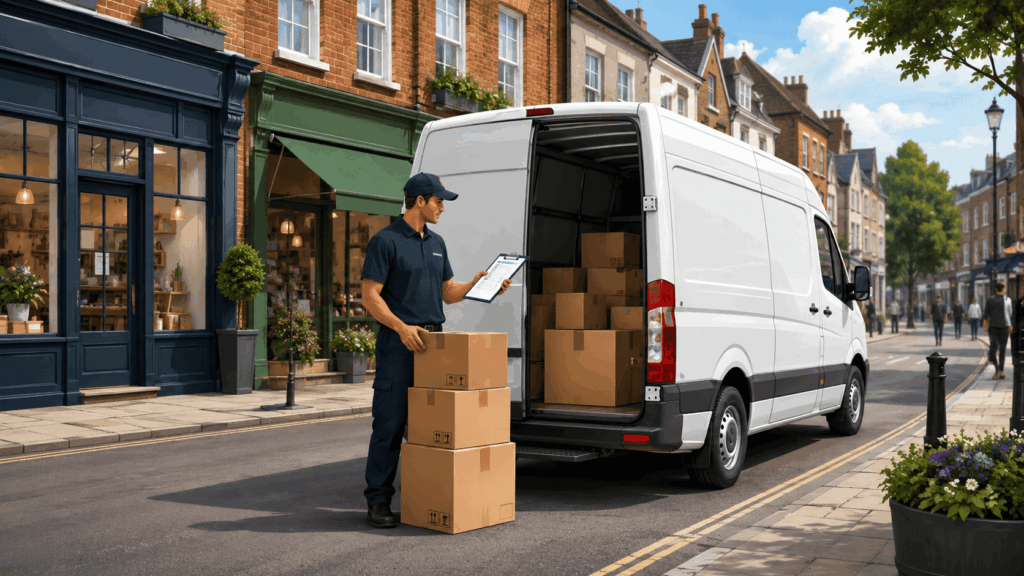
For many small businesses, delivery is not a one-stop task. A typical working day may involve collecting stock from a supplier, dropping orders at several customer addresses, delivering equipment to a job site, and returning paperwork or unused goods to the office.
Managing these journeys separately can increase costs, waste staff time, and create avoidable delays. A well-planned multi-drop delivery service combines several collections and deliveries into one organised route.
LuckyVan supports small companies across London and the UK with flexible van transport for stock, parcels, equipment, retail goods, and time-sensitive business deliveries.
What is a multi-drop delivery service?
Multi-drop delivery means one vehicle completes several collections or drop-offs during a single journey. Instead of booking a separate courier for every address, the route is planned around all required stops.
This type of business delivery service can be used for local routes, regional distribution, or longer journeys involving several towns. It works particularly well when goods are too large, too numerous, or too important for a standard parcel network.
Multi-drop delivery vs standard parcel courier
A standard parcel courier usually moves goods through sorting centres and shared delivery networks. That model can work well for individual boxes, but it may not suit businesses that need:
- several deliveries completed in a specific order
- direct transport without warehouse transfers
- bulky items, stock, or equipment
- confirmed collection and delivery windows
- one vehicle dedicated to the whole route
A dedicated multi-drop courier service keeps the load together and follows a planned sequence of stops. This gives the business more control over timing, handling, and communication.
Which businesses use multi-stop delivery?
Multi-stop van delivery can support many types of organisations, including:
- online retailers and independent shops
- florists, caterers, and event suppliers
- property managers and maintenance teams
- tradespeople and construction contractors
- offices moving equipment between locations
- wholesalers and local distributors
📦 Even a company with only three or four regular stops may save time by combining them into one route.
When multi-drop delivery makes business sense
Multi-drop delivery is useful whenever separate bookings create unnecessary duplication. The strongest benefits usually appear when several addresses are located within the same area or along a logical route.
Retail stock and store replenishment
Shops may need stock collected from a warehouse and delivered to one or more branches. A multi-drop delivery service can transport cartons, display materials, packaging, promotional products, and seasonal stock in one run.
This approach is especially useful when each branch needs a different quantity. The load can be organised by stop before departure, making unloading quicker and reducing the risk of mistakes.
Deliveries to several customers
Small businesses often have multiple customer orders ready at the same time. Rather than sending every order through a separate service, a dedicated van can complete all deliveries directly.
This works well for:
- furniture and homeware orders
- boxed products
- business supplies
- equipment rentals
- large or fragile goods
- trade and building materials
A direct route also reduces the number of times goods are handled before reaching the customer.
Collections from different suppliers
A multi-stop route does not have to begin with a single collection. LuckyVan can help plan routes that include pickups from several suppliers before the final delivery.
For example, a contractor may need materials collected from two merchants and equipment picked up from a storage unit before travelling to a job site.
Events, exhibitions, and temporary sites
Event deliveries often involve several locations, strict access times, and equipment that must arrive in the correct order.
A planned route can include collection from an office, a storage facility, a print supplier, and a catering company before delivery to the venue. After the event, a return route can also be arranged for equipment, displays, unsold stock, and packaging.
Benefits of multi-drop delivery for small businesses
Reduced transport costs
Combining several stops into one booking is often more efficient than arranging individual deliveries. The exact saving depends on distance, time, access, and vehicle size, but route consolidation helps reduce repeated collection fees and unnecessary mileage.
Less time spent coordinating couriers
Booking several couriers means managing multiple arrival times, contact details, invoices, and tracking updates. With one multi-drop courier, the business has a single route plan and one main point of contact.
Better control over delivery order
Some deliveries are more urgent than others. A planned route allows priority stops to be scheduled first, while flexible addresses can be completed later.
This is particularly useful when a customer, venue, shop, or construction site has a fixed delivery window.
Direct handling of goods
Goods remain in the same vehicle instead of passing through several warehouses or sorting hubs. This can reduce unnecessary handling and is useful for fragile, bulky, high-value, or business-critical items.
More professional customer service
Clear delivery windows and organised routes create a better experience for customers. Reliable business delivery can also help protect relationships with retailers, clients, venues, suppliers, and contractors.
How to plan an efficient multi-drop route
A successful route depends on more than placing addresses in order. Traffic, unloading time, access restrictions, and customer availability all need to be considered.
Step 1: Prepare a complete stop list
For every collection and delivery, provide:
- full address and postcode
- contact name and telephone number
- collection or delivery time window
- item quantity and approximate size
- access and parking details
- special handling instructions
Missing information can result in waiting time, failed deliveries, or delays at every later stop.
Step 2: Mark priority and fixed-time stops
Some addresses may only be accessible at a particular time. Others may be flexible. Highlighting this before route planning helps create a realistic schedule.
Examples of fixed-time stops
- a shop that opens at 10:00
- a construction site with booked unloading access
- an exhibition venue with a delivery slot
- an office that closes early
- a warehouse with scheduled collection times
Step 3: Organise goods by delivery order
Items for the final stop should normally be loaded first. Goods for the first delivery should remain easiest to access.
Correct loading prevents repeated rearranging and speeds up each stop.
✅ Labels showing the postcode, customer name, or stop number can make unloading much more efficient.
Step 4: Allow realistic unloading time
A box delivery may take only a few minutes. Furniture, pallets, stairs, loading bays, customer checks, and long carries can take much longer.
A reliable schedule should include enough time for each stop, not only the driving distance between addresses.
Choosing the right van for multi-drop delivery
The correct vehicle depends on the total size of the route, not only the largest individual order.
Small and medium vans
A small or medium van may suit:
- boxes and small stock
- documents and promotional materials
- compact equipment
- light retail deliveries
- small spare parts
These vehicles can be easier to park and manoeuvre in busy urban areas.
Long wheelbase and extra-long wheelbase vans
LWB and XLWB vans are useful for larger stock volumes, long items, several furniture pieces, and routes where the load must be divided between different customers.
Luton van with tail lift
A Luton van may be the right choice when the route includes:
- heavy appliances
- large furniture
- pallet-sized loads
- high-volume stock
- goods requiring mechanical loading assistance
Sharing photos and dimensions allows LuckyVan to recommend a suitable vehicle before the booking is confirmed.
What affects the cost of a multi-drop courier service?
The price of multi-drop delivery usually depends on:
- total route distance
- number of collections and deliveries
- estimated loading and unloading time
- vehicle size
- waiting time and restricted access
- urgency and required delivery windows
- additional assistance at each stop
The most accurate quote comes from a complete route plan. Stops or large items added after booking may affect the schedule and final cost.
How to reduce delivery delays and costs
Keep goods ready before collection
Stock should be packed, labelled, and positioned for loading before the van arrives. Waiting for orders to be prepared can delay every later delivery.
Confirm recipients in advance
Make sure each customer, branch, supplier, or site contact knows the expected time window and can answer the telephone.
Provide clear access instructions
Mention loading bays, security gates, stairs, vehicle restrictions, permits, low entrances, and parking rules before booking.
Avoid unrealistic time windows
A route should include a sensible allowance for traffic and unloading. Several narrow delivery windows may require a different schedule or more than one vehicle.
Book multi-drop delivery with LuckyVan
LuckyVan provides flexible multi-drop delivery for small businesses across London and the UK.
Whether you need to deliver stock to several branches, collect goods from multiple suppliers, or organise a time-sensitive commercial route, we can help you select the right van and create a practical schedule.
Ready to arrange your route?
🚐 Send us:
- all collection and delivery postcodes
- preferred time windows
- an item list with photos or dimensions
- access and parking information
Contact LuckyVan today for a clear multi-drop delivery quote and keep your business moving with one organised, reliable van service.
📲 Stay Connected
Follow us for real delivery stories, customer shoutouts, and special offers: